
Actemium Engineers’ Adventures at Sea: Providing Support on a Ship with a Clean-Energy Mission
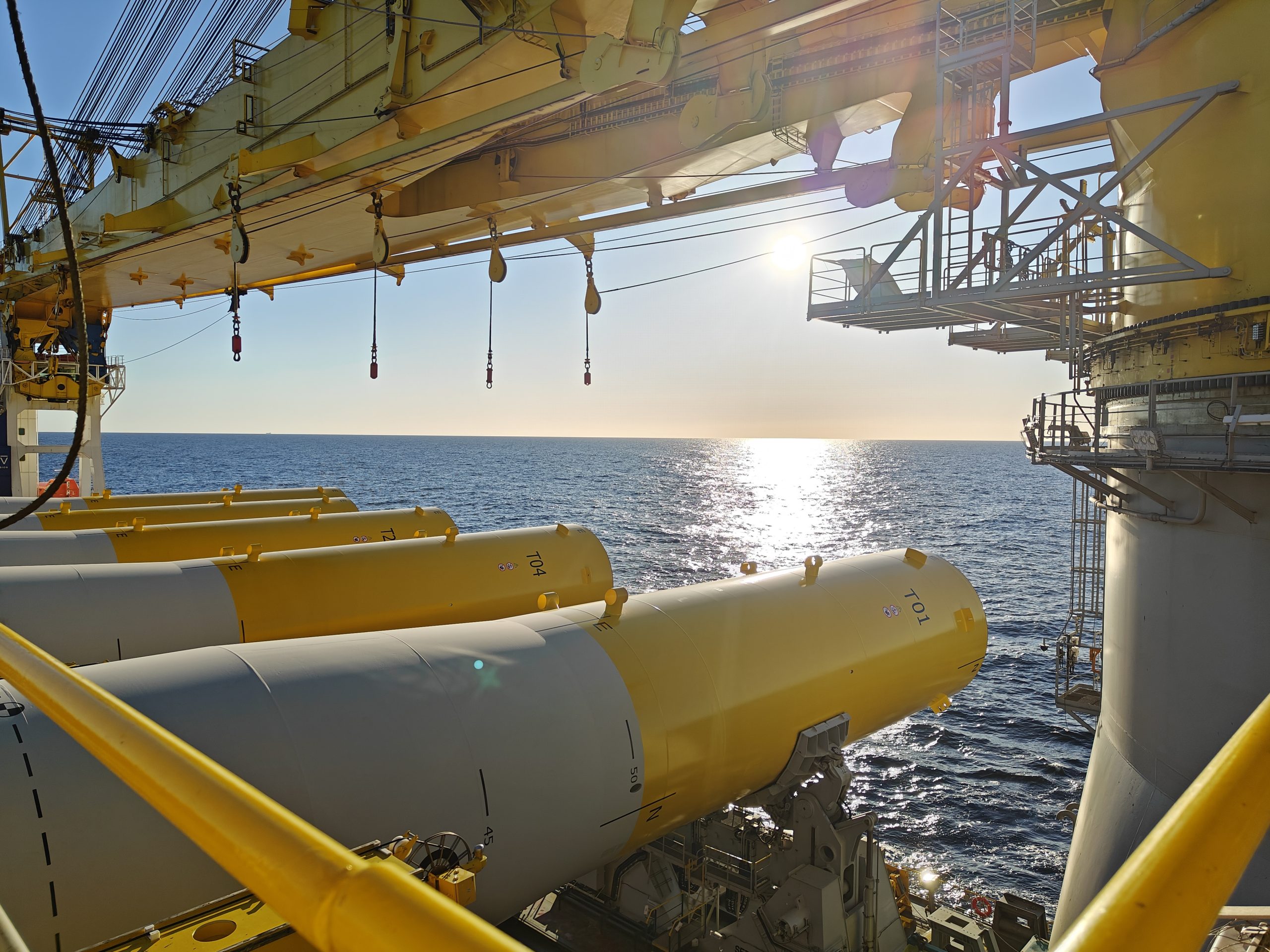
Every facet of Actemium's strategy relies on finding very talented people. Bringing in the best engineers takes more than simply paying well, so it helps to have uniquely challenging projects that appeal to those with a strong sense of adventure.
Actemium’s work with Jan De Nul, a sixth-generation family-run engineering company based in Belgium, fits the bill perfectly. For more than a year, a handful of Actemium engineers have worked on the construction of massive offshore wind farms aboard Les Alizés, the world’s most advanced heavy-lift vessel. The ship’s mission? Carrying and installing the giant monopile foundations that support the wind turbines.
Les Alizés, commissioned in January 2023, is the only ship in the world that can transport, lift and place the monopile foundations that hold wind turbines in place. Usually one ship transports the monopiles, lifts them one-by-one with its crane, then hands them off to a second ship’s “gripper” for precise placement.
Advanced Automation at Sea
Our teams optimized the software for the eight Programmable Logic Controllers (PLCs, four active, four back-up) that control the ship’s motion-compensating pile gripper.
It’s a very large ship, so it doesn’t roll as much as you would think. But when you’re heaving one of these monopiles, which weigh more than a thousand tonnes, the ship kind of shifts a little bit
said Jordy Van Bever, an Actemium automation engineer who has spent more than 25 weeks aboard Les Alizés.
The ship is enormous, at 236 meters long and 52 meters wide. The automation engineers’ main job, optimizing the PLCs, is never finished. As more sensors are added to improve the accuracy of the gripper, “We have to incorporate data from those sensors into our PLCs and visualisation,” Van Bever said.
He added that all the data collected from the thousands of sensors on the ship had to be logged and sent onshore via satellite for processing and storing, where another team is constantly tweaking and smoothing out. “It’s really a lot of data because I think there’s 3,000 I/Os (input-outputs) on the gripper alone,” Van Bever said.
Life and Collaboration Offshore
Les Alizés can place 2 or 3 monopiles per day if the weather is in its favor, which makes for very eventful workdays. After 2-3 weeks they take a helicopter or shuttle ship to shore for a well-deserved break.
Actemium’s partnership with Jan De Nul, which began more than a decade ago with undersea cable laying, underscores the company’s commitment to long-term customer relationships, which it achieves through its engineers’ excellence and flexibility.
Jan De Nul is also looking for long-term relationships, and they appreciate the flexibility of our teams
said Christiaan Van Landschoot, Business Unit General Manager at Actemium Belgium.
Van Landschoot added that the combination of technical challenging and adventure-rich projects like the ones carried out on Les Alizés were ideal for recruiting young talent. “Just last week we convinced a candidate who I knew had a better monetary proposal,” Van Landschoot said. With these sea-faring projects, new hires learn a lot and can travel the world, he added, listing Dubai, Indonesia, Brazil and Canada among the locations with similar projects.
And then there’s the extra, non-engineering training, which is required if you are taking helicopters to an “office” at sea. “We did about two weeks of training before going to sea,” Van Bever said. “First aid training, fire training, sea survival training.”One day they put us in this makeshift helicopter and dropped it in a swimming pool,” Van Bever said. “You have to wait with your instructor inside until it’s completely submerged. Then you have to knock out the window and swim out. It was a cool job, although not what I thought I was going to be doing when I was studying to become an automation engineer.”